H. I WAS THERE; NOW I AM HERE

Taken from A Patchwork Life: The Hands-On Guide To Living by Louise Silk

Available as an ebook: A Patchwork Life: The Hands-On Guide To Living 
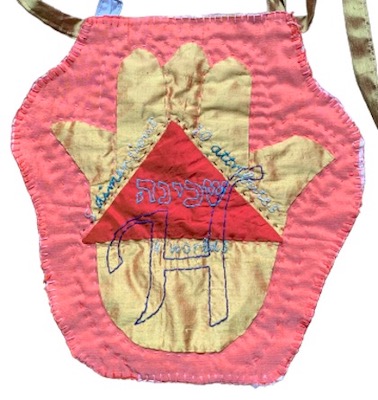
Shekinah/Feminine Aspect Of G-d; 14”H X 14”W;
Hand Stitched Silk; Old Quilt Backing; 2020

When I proposed this exhibition to the JCC on September 21,1992, I had two goals. I wanted to explore the interactive quality of art quilts, my artistic medium for over 20 years. Also, I wanted to learn enough about being Jewish to portray it visually. My larger objective was to combine my vocation as a quiltmaker with my avocation as an active member of the Jewish community. Louise Silk; Artist Statement; Feb. 2, 1994

While my parents had little interest in religion, I was attracted. I enrolled in the afterschool program at the College of Jewish Studies and took a high school English elective on the Hebrew Bible as literature. My father often told me that I would make a good Rebbitzin (Rabbi’s wife). Along with the thinking of the times, the idea of a girl becoming a Rabbi was beyond our grasp.

Years later, a synchronicity of events began with the opportunity for an adult Bat Mitzvah. I joined a group of women at my childhood synagogue learning to chant torah and haftorah and stood before the congregation as a religious adult. Having no understanding of Jewish practice (like how the calendar revolved around the moon or why people stood during a service), learning as an adult allowed for critical thinking and understanding that heightened the religion’s meaning for me.

Building on my knowledge base as an adult Bat Mitzvah, taking advantage of the large window I had to prepare an exhibition, I created a curriculum of books, classes, and private study all with the goal of building a body of quilts about being Jewish.

Some pieces developed easily: Six Days We Create, a quilted microcosm of the active involvement of humans in creation, was a book where the viewer could co-create by turning the pages. With Knowledge, Comes Faith, a stamped collection of truisms was a satisfying way to catalog all of the revealed noteworthy facts that I found enlightening or stuck a cord of agreement with me. 

Others were particularly challenging: For The Prayer Project, I wanted to create an organized aesthetic experience for the viewer to participate in group prayer, as compared to the haphazard way it occurs at the Western Wall. For Bring About Olam Ha BaThe World To Come, I wanted a view of a perfected world where each individual could agree to participate by taking a ribbon stamped: I join in our task to create WORLD PERFECTION.

On a trip to Israel, I met an orthodox rabbi who challenged me to search for the things in the religion that worked for me, rather than criticize all that I found unpalatable. In doing that, I agreed to study with him. 

It was frustrating. He would explain an orthodox practice. I left uncertain and scrutinized what I had heard, uncovering some fallacy, mostly based on a negating view of women. I returned with a challenge. He would suggest additional justifications that continued to make no sense.

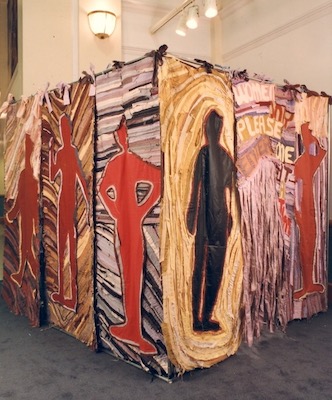
I became so angry with this orthodox view of women that I thought about making an artistic statement by erecting a mechitzah, the partition that separates women from men in the synagogue, in the gallery and throwing blood on it.

This action being unrealistic, I labored my way through to something positive: Men create a separation to exclude women. I will create my own separation to exclude men. Women have a spiritual nature that is legitimate and respected. I will make a space for women to explore their true spiritual nature. I will make a tent, an enclosed space for women that excludes men.

I purchased a support structure. I designed the outside with visual images of women’s souls. The inside was a serene quilted landscape, with music, pillows, and writing materials. It took the entire summer to complete the construction, all the while, releasing my anger into the foot pedal of my sewing machine.

Further into my study, I saw an ad in our Jewish newspaper for the formation of a women’s Rosh Hodesh group. Rosh Hodesh is the celebration of the new moon, traditionally a woman’s holiday. Each month, thereafter, I joined feminist contemporaries for Hebrew celebrations of the new moon. We created rituals, studied innovative interpretations of texts, expanded holiday applications and developed Jewish meditative practices.

One of the participants was a young female Rabbi. To decide on a meaningful opening, beyond wine and cheese, I consulted with her. She listened to my process and told me it sounded like I was trying to find my voice. There was a term in Judaism, Kol Isha– women’s voice. It was mostly a negative term. Men should not hear women speak for fear it might incite them sexually.

My assignment was to make Kol Isha positive. Starting with the Hebrew Bible and going through herstory, I located statements spoken by Jewish women. I asked 36 women, the number of righteous individuals on earth at any time, to participate. Each read a different woman’s words standing in the gallery at a pre-designated place so that their bodies formed the letters representing the word VOICE. I became the dot on the I, my mid-life point. Being 43 at the time, content to live until 86, I titled it my Mid-life Ritual.
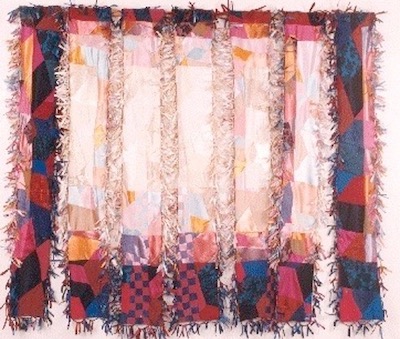
Bringing About Olam Ha Ba/The World To Come; 66”H X 72”W;
Pieced and Quilted Satin with Hand Stamped Ribbon;1994

C. JEWS ARE NOT QUILTERS QUILTERS ARE NOT JEWISH

Taken from A Patchwork Life: The Hands-On Guide To Living by Louise Silk

Available as an ebook: A Patchwork Life: The Hands-On Guide To Living 

Stetl/Community; 14”H X 11”W;
Hand Stitched Silk; Old Quilt Backing 2020

Quilt making generally regarded as an American form, most European-born women learned the skill here. Jews tended to congregate in large cities, associating almost exclusively with other Jews. For most, quiltmaking was an invisible, alien craft. How did Katie come to make quilts, when so many other Jewish grandmothers did not? Could the difference be the result of her assimilation with her “American” neighbors?

Julie Silber; A Family Story in Cloth

Pretty much from the beginning, I understood that quilters were not Jewish, and Jews did not quilt. Because it was rare to find a Jew among my quilting contemporaries, I made the faulty assumption that Jewish women by nature did not have the patience for quilting. In some crazy unknown way, I was the exception.

With this rationale, it made sense to me to keep my Jewish life as a volunteer and my work as a fiber artist, completely separate. There were many examples of this, like that I steered clear of a beautiful gallery at the Jewish Community Center as too Jewish, and assumed Jewish women enrolled in my class would not be able to master the craft.

On the odd occasion I met a Jewish woman who told me there were quilts in her family, I quickly discovered that either she was a convert with a non-Jewish mother, or her mother had grown up in a very small town, isolated from the larger urban Jewish community. 

Some years later, an article by a curator explained that American Jews, like other ethnic groups, lived together in shtetl-like communities practicing the needlework popular in their countries of origin. For European Jews, it was embroidery, cross stitch, knitting, and crocheting. It is not until we get to be assimilated in American culture, that we become exposed to and then involved in the American craft form of quilting. 

This new understanding of the confluence of being both Jewish and a quilter, influenced my quest to find a new and innovative quilting subject. I was the head volunteer for the local resettlement of Soviet Jews. Pittsburgh settled 540 individuals as a part of our participation with the international community. To organize this, I attended regular meetings. Driving home after a meeting, I had an ah-ha moment: the thought that infusing my quilts with some kind of Jewishness, might somehow forward my work.

The first piece was a small applique diptych about the Russians. On the left, the Russians standing in a long line wearing drab browns. On the right, they danced the hora in bright pastel colors. The second was a curtain, representing the fall of the Berlin wall, with patchwork words like freedom and perestroika.

Following those, I made a piece envisioning my authentic Jewish self. I shared the quilt with the JCC gallery director and agreed to an exhibition 2½ years ahead in February 1994. The idea was to develop my personal individual Jewish identity and practice through the process of making the quilts.

Entering The Garden: A Woman’s Spiritual Tent;
8 Ft X 8Ft X 7 Ft; Outside: Machine Pieced Rag Strips;
Inside: Machine Pieced and Quilted Cottons; 1994
Collection of Jaffe Center for Book Arts, FAU

T. THE ARTIST WITHIN

Taken from A Patchwork Life: The Hands-On Guide To Living by Louise Silk

Available as an ebook: A Patchwork Life: The Hands-On Guide To Living 

Tiferet/Acceptance; 10”H X 14”W;
Hand Stitched Silk; Old Quilt Backing 2020

Art is an act of the soul, not the intellect. When we are dealing with people’s dreams – their visions, really – we are in the realm of the sacred. We are involved with forces and energies larger than our own. We are engaged in a sacred transaction of which we know only a little: the shadow, not the shape.

Julia Cameron

Increasing my skills was important to pay the bills but it was not enough to secure my mounting desire to be a legitimate fine artist. Having no formal art education, I invented my own rigorous contemporary arts curriculum based on studies from a high school art history class.

I began reading contemporary art magazines cover to cover. I organized visual images from them into a series of notebooks for inspiration. I sought out contemporary art collections in my travels. I explored the works from the permanent collection at the Carnegie and its International Biennials. I studied color via Joseph Albers, fiberart via Sheila Hicks, contemporary art via Frank Stella, feminist art via Barbara Kruger, self-referencing via Cindy Sherman, installations via Ann Hamilton; to name just a few of my favorites.

Somehow, I decided that to be considered a serious artist, I would have to have a one-person exhibition. There were very few places in Pittsburgh to accomplish this, but one possibility was the Associated Artists of Pittsburgh (AAP) gallery, then at the Pittsburgh Center for the Arts (PCA). I set in motion a plan to jury into AAP and apply for a gallery show. I successfully accepted into the organization and was granted the one-person gallery exhibition in 2 ½ years, for July,1987.

To create a related body of work, I settled on what seemed like a liberating idea: to break out of the basic quilter’s block. I started with an odd sized rectangle 6” X 36” and with each additional artwork, moved beyond it. I varied the block’s size; I gave the block three dimensions; I made multiple varied blocks in one piece; I took away the background; I changed the point of view; I turned the blocks into buildings; I added trees; I made ceiling and floor quilts; and finally three-dimensional objects.

The third in the series was a king-size bed quilt of three-dimensional shapes and the shadows reflected from them. The preeminent international quilt competition of the day was Quilt National (QN) in Athens, Ohio. This quilt seemed complex enough to be QN worthy. It’s time-frame conflict with my exhibition, but I decided I would forego including it, if it was accepted to QN. It was.

I had accomplished every one of my goals for this monumental first exhibit, including being accepted into Quilt National, but sadly, instead of feeling satisfied with the accomplishment, I was depressed and disappointed. I felt inadequate and frustrated. It simply wasn’t good enough to have a single one-person exhibition. In the end it was only a tiny step along the path of being a successful artist and I felt like I had a long way to go.

A. WHOMEVER DIES WITH THE MOST FABRIC WINS

Taken from A Patchwork Life: The Hands-On Guide To Living by Louise Silk

Available as an ebook: A Patchwork Life: The Hands-On Guide To Living 

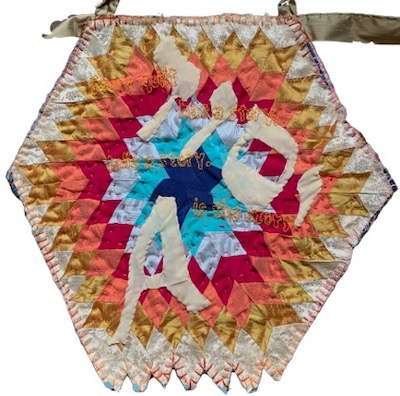
Yesod/Longing To Connect; 12”H X 12”W; 
Hand Stitched Silk; Old Quilt Backing; 2020

By definition, a quilt has three layers of material joined together by hand and/or machine stitching. The top layer is an intricate composition of different multiple threads, fibers, and knots. On the back, a gathering of hundreds upon hundreds of stitch indentations display a proud testament to the work of the quilter.

Louise Silk; The Quilting Path; page xi

In 1978, my husband and I moved back to Pittsburgh with a one-year-old in tow. It happened through a series of events: we lost our apartment, he had trouble finding a job, raising children seemed easier to do with family support. While we were winding our way back to our hometown by traversing the United States, my mom found us a house: a two-story red brick on a cul-de-sac. It’s a good solid house, she said. Make it yours.

Once we were home, locals suggested two activities for me: Mother’s Day Out and The Embroiderer’s Guild. I joined both. At Mother’s Day Out, children are cared for separately while mothers attend classes and talks. I taught a class following my Chicago experience using the Our Bodies Our Selves curriculum. Pittsburgh moms, although they were good sports about it, were not quite ready to examine their own cervixes.

I switched to teaching a quilting class, where I struck gold. That class extended into a weekly quilting circle and in time my role morphed from teacher into purveyor of quilting supplies. Eventually, that transformed into a retail storefront selling all things related to quilting. 

At the time, there were no quilt shops. Chain fabric shops sold mostly dress making fabric and absolutely none of the 100% cotton required for serious quiltmakers. There was no on-line shopping. Mail order was a complicated process, sending for swatches and hoarding purchases to get ahead of sellouts. 

One of the members of our circle was contacted by a quilting group in Greensburg struggling to find a local retailer. It was easy to be convinced, with the additional incentive of building our own stashes, we could be that supplier.

We pulled together eight hundred dollars and bought twenty-yard bolts of 100% cotton fabric, along with all the basic quilting supplies. We set up a makeshift shop in my basement and sold materials to the Mother’s Day Out students, members of the Greensburg Quilting Guild and the local Embroiderer’s Guild. Things developed. We reinvested all revenue to buy more bolts of 100% cotton fabric, plus innovations like the rotary cutter, the pvc quilting hoop and an ever-increasing selection of quilt publications. We became the Pittsburgh connection to a national quilt revival movement.

Finally, with an over-run basement of supplies and the investment of a third quilt-circle member, we opened our first retail establishment. Over the next four years, we grew and moved from one location to another, eventually ending at the local mall. At each juncture we added products, classes, and events that placed us, squarely, at the cutting edge of an exciting quilt movement. Unfortunately, we were never able to become profitable and closed the latest retail storefront in 1989. 

Motivated by a bank debt of thousands of dollars, I employed my knowledge and skills to explore the business of quilt marketing and production. I created products for wholesale, solicited commissions, and committed to teaching opportunities that paid down the debt and added to my status as a professional craftsperson.

The other significant influence on my quilting life was the Embroiderers Guild. I juried in as an active member with an original needlepoint and a graphic log cabin quilted hanging. During my tenure, I held many postions in the guild and was instrumental in the name change to Fiberarts. I learned innovative needlework techniques and met many national recognized fiber artists. I learned the business of entering shows, documenting and photographing finished work, and building a resume. 

I was empowered with knowledge and skills as the result of both experiences and that translated into highly innovative quality work. Within my quilting circle, I felt the continuation of value and success that began in Chicago.

P. From Under The Sheet

Taken from A Patchwork Life: The Hands-On Guide To Living by Louise Silk

Available as an ebook: A Patchwork Life: The Hands-On Guide To Living 

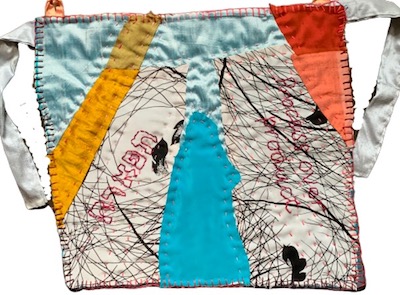
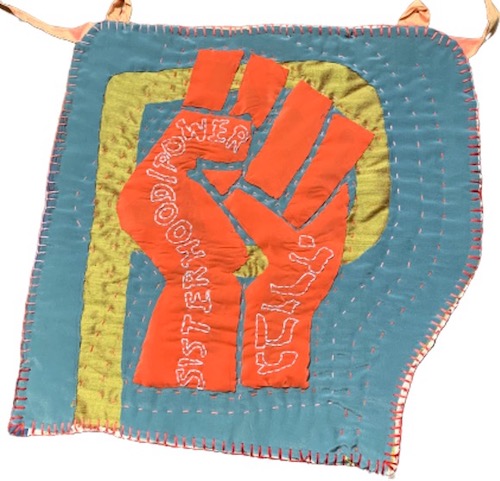
Gevorah/Strength; 10”H X 14”W;
Hand Stitched Silk; Old Quilt Backing; 2020

The feminist revolution had to be fought because women quite simply were stopped at a state of evolution far short of their human capacity.

Betty Friedan; The Feminine Mystique; 1963

The disappointment I harbor that we haven’t come to a place of gender and racial equality in my lifetime is deeply palpable. A religious teacher, observing the look of frustration and disappoint on my face as he explained a Jewish law that excluded women, counseled that I needed to be patient, the women’s movement is young; significant change takes time. 

On one hand, current society is woefully derelict in its vision and practice of all things equal. On the other hand, considering that growing up well into my late teens, I thought my only job was to stand beside my man and look cute, I surrender to the realistic nature of progress over perfection. I admire and support my revolutionary sisters who employ more radical means, but it’s not me.

My feminist trajectory began in the early seventies with a phone call from a neighbor organizing a women’s conscious raising (CR) group to investigate all aspects of womanhood.

During weekly evening meetings, members pursued grassroots liberation, one by one, with an eye-opening series of questions and discussions. Topics included non-traditional living situations, altering gender roles, equal opportunities in the workplace, increasing access in education, body politics and sexual liberation. Every word, piece of writing, and discussion was totally revelatory and shocking for me.

The decision to quilt came from the serendipity of an article in MS Magazine about quilting making as a woman’s art form. I identified with the idea presented that men having little interest in needlework, left women unsupervised to explore the craft on their own.

My Home Economics training and my consciousness raising came together in the creation of my first quilt, a queen-sized machine-pieced hand-quilted grandmother’s flower garden. Over the year and a half, it took to make that quilt, a lifelong passion came into being.

While feeling the dissent festered and gnawed within me but being resistant to change, I clung to my traditional model, finishing my degree in Home Economic Education and marrying my high school boyfriend.

Our relocation to Chicago in 1973, was the prelude to action. Looking to meet people, I answered an alternative newspaper’s ad gathering women to fight for legalized abortion. Through that, I became a member of Health Evaluation and Referral Service (H.E.R.S.) where I learned how to negotiate and evaluate a medical system that had no consideration for women’s rights.

Our focus was on a woman’s right to free choice in all things related to health, exposing medical issues such as faulty health research, limited birth control, inadequate health education, sexual wellness, and legitimatizing homosexual rights.

The main source of our inspiration was the Boston Women’s Collective book, Our Bodies, Our Selves. We sold it, as available then, in a thirty-five cents newspaper print edition. Through its guidance, we explored cervical self-exams, vegetarian diets, self-aware orgasms, and the politics of male-denominated control in all things related to health.

Our main action was evaluating abortion clinics and then making referrals by way of a hotline. There was no government regulation of clinics at that time. In addition, we opened a free clinic where we taught classes, disseminated birth control and monitored legal battles.

This was my first experience with a like-minded women’s collective, offering leadership training and positive reinforcement. H.E.R.S. built confidence. This applied first and foremost to the women’s healthcare system but also spilled over to each of our individual skills. H.E.R.S. showed me that quilting had value and that it was my particular skill set to contribute to the group. We had quilting retreats at a member’s family camp where I taught everyone to quilt. We organized group quilts to celebrate life events. My time with H.E.R.S made me feel valued, both as an advocate for women’s health and as a teacher of a women’s craft form.

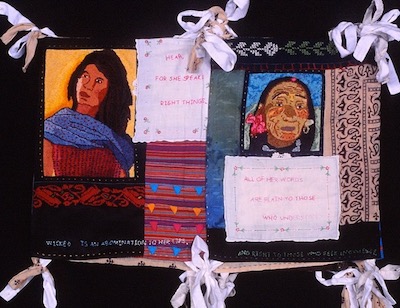
Wisdom Congregation; 14”H X 95”W X 1D”; Accordion Book composed of 10 Hand Embroidered Women’s Faces; Clothing Remnants, Text-Embroidery Embellishment; 2003.
Collection of Jaffe Center for Book Arts, Florida Atlantic University

A. TRUTH

Taken from A Patchwork Life: The Hands-On Guide To Living by Louise Silk

Available as an ebook: A Patchwork Life: The Hands-On Guide To Living 

Emet/Truth; 10”H X 10”W;
Hand Stitched Silk; Old Quilt Backing; 2020

…feelings like disappointment, embarrassment, irritation, resentment, anger, jealousy, and fear, instead of being bad news, are actually very clear moments that teach us where it is that we’re holding back. They teach us to perk up and lean in when we feel we’d rather collapse and back away. They’re like messengers that show us, with terrifying clarity, exactly where we’re stuck. This very moment is the perfect teacher, and, lucky for us, it’s with us wherever we are.

 Pema Chödrön

I am the descendent of a particularly action-oriented mother and a singularly open-hearted father, neither of whom expressed their feelings. I wrote a three-volume set, Threads, about their lives to help me resolve life-long unexpressed emotions that had affected my physical well-being. It worked. I created a written legacy for my children and resolved a host of inherited family difficulties that had heretofore harmfully impacted my life. The process helped me to accept my life as it is, with much less judgement.

Writing A Patchwork Life is the next step to acknowledge and appreciate the emotional and spiritual underpinnings that have driven my life-long passionate participation in an art quilt movement.

Over the years, I have produced a mountain range of patchwork quilts. Creating patchwork requires such skills as discernment, vision, organization, determination, practice, patience, and compromise.

Using patchwork as a metaphor for the piecing together of other aspects of life: making dinner, organizing a ritual, having a conversation, writing a blog, making a book, requires the identical skills of combining seemingly disparate things into an aesthetic meaningful whole. My quilt experiences culminate here as a display of my particular capacity to piece together just about anything.

Howie and Weezie; 5” Square;
Hand Embroidery; 1998;
Private Collection

My PatchWork Life

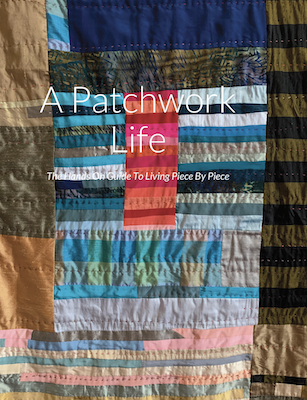
A PatchWork Life: The Hands-On Guide To Living Piece By Piece

Taken from A Patchwork Life: The Hands-On Guide To Living by Louise Silk

Available as an ebook: A Patchwork Life: The Hands-On Guide To Living 

is a short herstory of my quilt making world. Beginning with this blog entry, I will post pieces of it. Enjoy!

Back Cover Statement

EPILOGUE:

THE QUILTS THAT PIECE THIS TOGETHER

This is the time to be slow,

Lie low to the wall

Until the bitter weather passes.

Try, as best you can, not to let

The wire brush of doubt

Scrape from your heart

All sense of yourself

And your hesitant light.

If you remain generous,

Time will come good;

And you will find your feet

Again on fresh pasture of promise,

Where the air will be kind

And blushed with beginning.

John O’Donohue

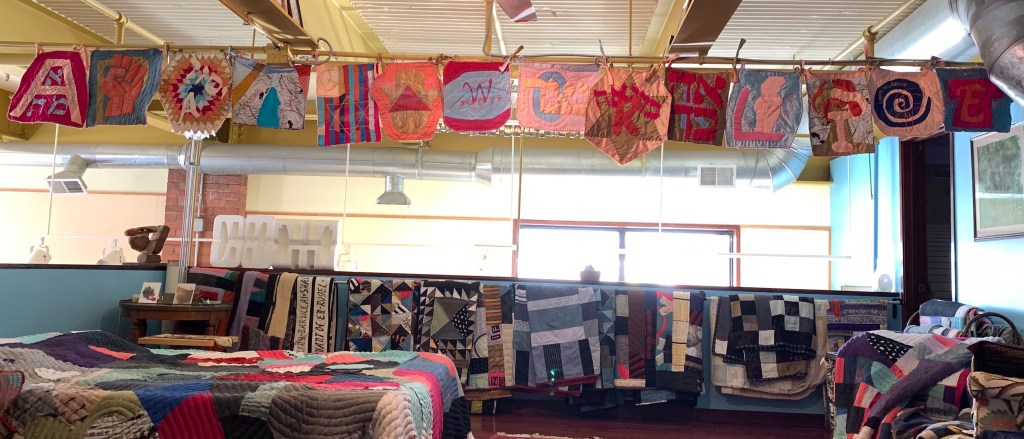
Fourteen Flags Installed
Flags

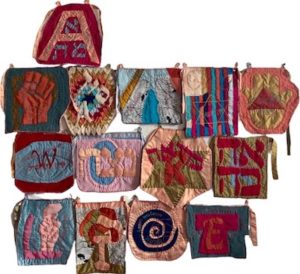
I was in process on this project when the world was struck by COVID-19. Our altered daily lives encouraged my deep dive producing fourteen flags, a kimono, and a quilt that visually piece together this writing. 

The textiles I gathered are the leftover silks on hand. Most, my parents brought me from travels, difficult to use, but significant in memories. The idea to use flags came from creating Tibetan flags for our garden and a flag installation on the High Line in NYC.

The chapters follow the letters of the title. For each letter/chapter, I pulled out its underlying theme, searching for a Hebrew word or expression that exemplifies it.

A. Emet/Truth: True Self is simple; ego makes it complex.

P. Gevorah/Strength: Sisterhood is powerful.

A. Yesod/Longing to connect: Every quilt tells/is the story.

T. Tiferet/Acceptance: Integration. Process over product.

C. Stetl-Community: If not now, when?

H. Shekinah/Feminine aspect of G-d: 4 worlds, 5 dimensions,10 attributes

W. Kine-Ahora/No Evil Eye: All change begins within.

O. Netzach/Victory

R. Briah/Acceptance: Life is pure creative energy.

K. Ahava/Love: Synchronicity

L. Besherit/Meant To Be: Wisdom plus understanding

I. Ayeh Hasher, Ayeh/I Am Who I Am: So above, so below.

F. Chocmah/Wisdom: Layers upon layers.

E. Ain+Yesh/None+All: The quilt as metaphor for life.

Flags

I want to start off by acknowledging that I am very aware that I have quite the advantage with this working at home situation. Having spent years alone in my studio, I very simply see this time as one more opportunity to hunker down with my current project: 14 flags to illustrate my in-process writing: A PATCHWORK LIFE.

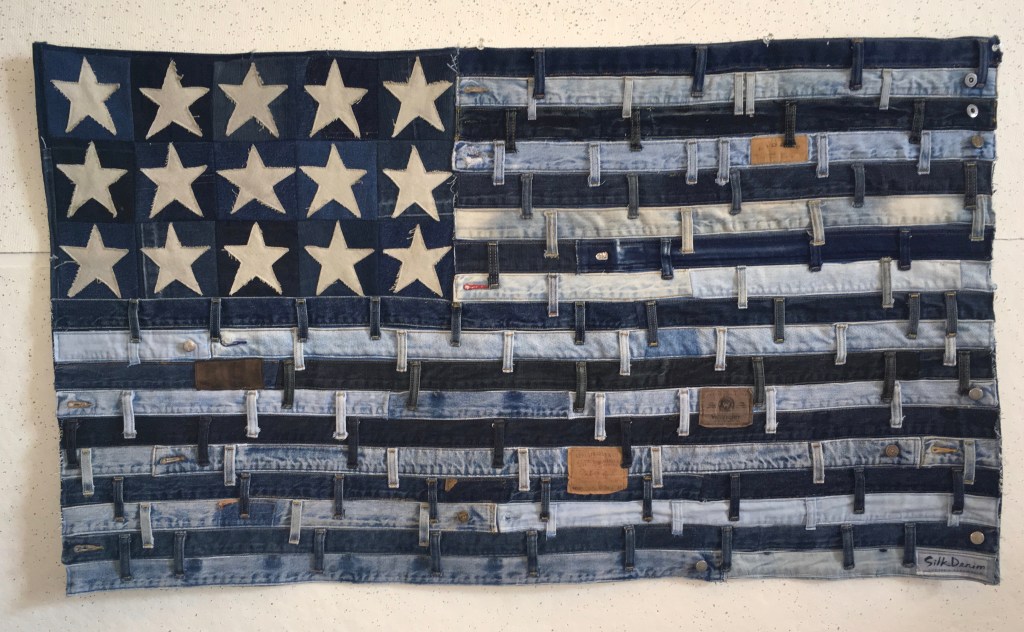
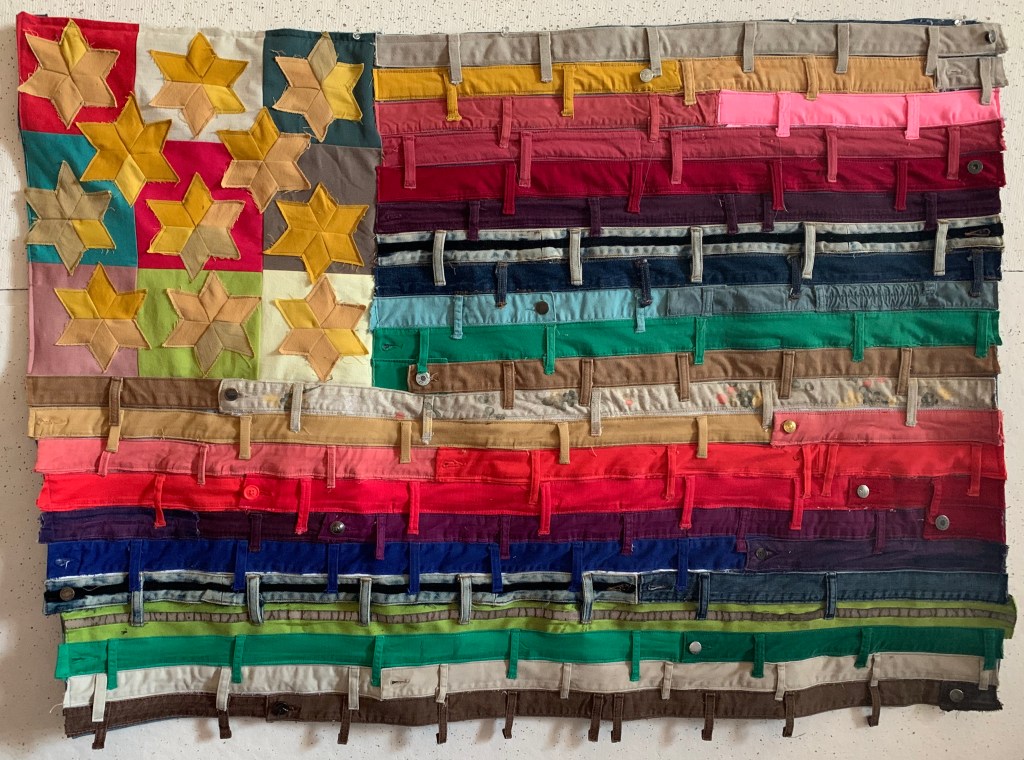
My interest in flags came from two sources: first a commission for a DC hotel and second my husband, Steve’s desire to produce his own prayer flags.

Steve’s Flags
SilkDenim Hotel Commission

In response to the Tree of Life Massacre I made this flag:

And a trip to NYC helped with my inspiration:

And yet another commission:

D.C. Denim Flag

And now a hint of more to come:

Flag C

Next Year Safe and Healthy

Each person in our family received the following list to prepare for Wednesday’s Seder. Maybe you will find it helpful:

2020/5779 SEDER MENUCHAT HANEFESH-CALMING THE SOUL IN DIFFICULT TIMES

For this Stay-at-home Seder, you will prepare your own food. While making your choices, keep in mind what the traditional food represents and select an alternative food easily available to you during these circumstances to use as a replacement. 

Candles and matches- any kind on hand

Soup- Chicken soup is undoubtably the symbol of Jewish cuisine but for this, use your favorite go-to comfort soup, something easily made on hand: packed noodle, canned or boxed soup.

Wine– In our tradition, wine represents the life force and the hope/blessing for fertility. Use whatever drink(s) give you hope for better blessings.

Matza- Our bread of affliction (Deuteronomy 16:3) is made of only two ingredients, water and flour signifying poverty and difficulty. As the bread of freedom it represents the byproduct of God’s swift and miraculous salvation liberating the children of Israel. As the food of faith, it imagines our afflictions as a precursor to redemption and links slavery to freedom. For your matza, choose a simple and unadorned basic nourishing food that gives you hope.

Seder Plate-These food together will serve as our main dish.

beitzah(egg)- represents new life and springtime- traditionally a roasted egg, but consider any form of egg, or any kind of seed or nut, an avocado or avocado pit, or even a flower

karpas(fresh vegetable dipped in salt water)- also spring, renewal, along with the tears of slavery- traditionally parsley- consider anything leafy or celery or avocado, or even a onion.

maror(bitter herbs)-the bitterness of our lives- traditionally horseradish – consider anything spicy.  

charoset(brick mortar)- the hardship of slavery- traditionally a mix of nuts, apples, and wine- try a mix of some kind of fruit and nuts like peanut butter and jelly or granola.

lamb shank, beets- bloodshed required to induce freedom- consider any slice of meat or beets or a yam, anything colorful.

orange(equality)- for all genders and races- this is for something you don’t normally see on a seder plate- so use your imagination.

olives (peace)- What represents peace to you?

carrots(sustainability)- a simple, practical, nutritious food.

potatoes(sustenance)- another basic practical, nutritious food.

fish(merit)- something a little extravagant 

chocolate(fair trade)- something that represents the rights of workers

Ezekiel Sandwich– a combination of any of the above to combine distinct flavors into the harmony of Oneness.

Cup of Miriam and Cup of Elijah– two extra cups one for your favorite drink and one for water.

Dessert- something sweet

Going Virtual

In this day, the world is filled with stories. Here is mine: an opportunity of a lifetime having a solo exhibition in a beautiful downtown gallery with weekly demonstrations to be with the public and then a pandemic that requires everyone to stay home.

Thank goodness, the sponsoring organization Contemporary Craft is onto creative alternatives to get the work: thus this interview with me. I am reblogging it here- mostly for my own documentation, but also if you haven’t see this before, another opportunity to enjoy!

Me at Fiberart International

Louise Silk is a Pittsburgh-based artist, writer, and quilter. For over forty years, she has been creating art that combines aesthetics and functionality with meanings and memories for family, friends, individuals, and organizations. In additional to creating exhibition-level artworks and running a zero-waste studio, Louise also join forces with her daughter at SilkDenim, a web-based shop selling one-of-a-kind, handcrafted 100% recycled clothing, bags, and quilts.

Her solo exhibition – ReNew – is on view at Contemporary Craft’s BNY Mellon Satellite Gallery in Downtown Pittsburgh through May 2020. Her artist demonstration on every Wednesday during the run of her exhibition is on hold due to the COVID-19 pandemic, so we are happy to share more about Louise and her creative processes here. Louise also sent us a video to show us her studio, so make sure to read until the end!

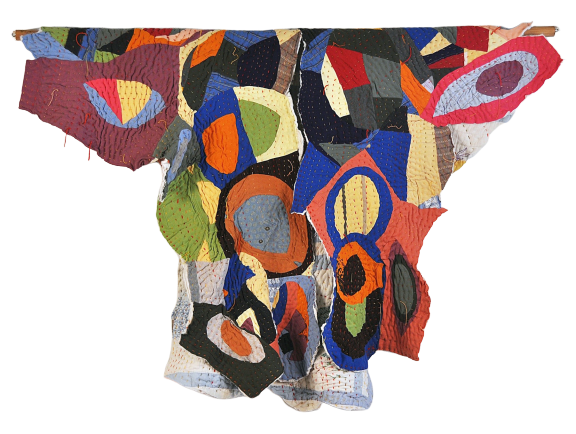
Rasiel’s Mantle

Contemporary Craft (CC): Can you describe your work that is now exhibiting in ReNew for people who can’t see it in person?

Louise Silk: The work is divided into three sections: “Quilts”, “Denim”, and “Words of Wisdom”. The quilts, mostly kimono shapes representing angels, are made of tee-shirt remnants in a freeform patchwork. Piecing circles, in combination with stretchy knits is technically demanding, making it fun to bring everything together into a workable format that transforms wasted cloth into a greater purpose.

I partner with my daughter, Sarah, as SilkDenim, where we emphasize the craft & beauty of re-making 100% recycled materials into individually crafted objects. Our mainstay is denim because of its rugged practicality and unique ability to improve with age. The pieces in ReNew use the most challenging parts of deconstructed denim: the waistbands, the back seams, and the pockets. In addition to the spiritually inspired angels, two of the denim pieces, Dina’s Coat of Many Colors Ketonet Passim and No Hate Flag, are politically motivated. Dina, the daughter of Leah and Jacob, is the biblical accounting of women’s violation and relates to the current #MeToo movement and No Hate Flag is my response to the lives lost at the Tree of Life massacre.

“Words of Wisdom” was inspired by traditional samplers that used phrases like “a stitch in time saves nine”. I modernized that idea by using encouraging phrases and quotes that permeate the internet today with the intention of creating a more positive dialogue during the current political environment. This is the project I worked on while doing artist demonstration on-site at my exhibition. I documented some of the work on my Instagram (@Silkquilt).

Detail of Dina’s Coat

CC: What draws you to fiber arts? Why were you drawn to upcycling and reusing materials?

Louise Silk: I have always been drawn to cloth. The only thing I did particularly well in high school was sew. I have a B.S. degree in Home Economic Education. The transformation to Fiber Art began with an article in MS Magazine in 1972 about quilting as a women’s art form. 

Fiber is pervasive throughout our environment and particularly relevant to our everyday lives, making it the perfect medium for unending exploration. Upcycling and reuse became the only sensible way to keep working sustainably within our current environment.

ReNew

CC: Tell us more about your how you work and about your creative process.

Louise Silk: It seems funny to say, but my work is very organic. I live in a 2700 sq. ft. loft with a plethora of materials. The content of my ongoing process flows from what’s on my mind, how I am feeling, what’s happening around me. 

CC: How does your background influence your work? And how has your work evolved over the years?

Louise Silk: I am in process on a memoir called “A Patchwork Life” that explores the evolution of my work. Once again, the best description is organic and fluid. The quilt I made in association with the writing is a series of fourteen flags – each representing a chapter of my work. I will also make a kimono/angel for it.

CC: What are your inspirations?

Louise Silk: Spirit practices like Zen and Kabbalah; engaging in a thoughtful process; contemporary art and artists; high fashion and interior design.

CC: What is your dream project? Or if you have completed one already, what is it?

Louise Silk: I would love to have a major gallery exhibit that was an enclosed environment made totally of quilts.

Contemporary Craft Drop In Studio

CC: What’s the most fulfilling part about being a maker?

Louise Silk: Every day is exciting and meaningful.

CC: Tell us about your favorite artist or artists that inspires you.

Louise Silk: My favorites are Louise Bourgeois and Magdalena Abakanowicz, both fine artists who use fiber in their work. 

CC: What role does the artist have in society?

Louise Silk: I have always been a little ahead and to the left of the general society and as much as that is true for other artists, we help to inspire and forge the path.

CC: What is the best piece of advice you received as an artist?

Louise Silk: Be open- don’t hesitate- discover connections-follow your gut- take it further.

CC: Lastly, what is art/craft to you?

Louise Silk: Pure inspiration.

Louise Silk: Studio Tour | Video by Steve Root

And also now a tour of the exhibition Renew: