Googled

Have you ever googled your name to see what shows up? I try to do it regularly, to make sure anyone interested in having a memory quilt made will find me easily. I search under SilkQuilt, BubbeWisdom and Louise Silk.

This week I discovered something very unusual. A local artist took my photo and made the “Louise Silk Shoe”.

I guess I should be honored that the self-appointed People’s Shoemaker included me with the likes of the “Andy Goldsworthy Shoe”, the “Manet Monet Sneekers” and his most recent “Justice For Trayvon”.

Funny- yes, entertaining- maybe, but I am totally flummoxed as to how I might translate this interesting publicity into more quilt business.

Schmatta For Sale

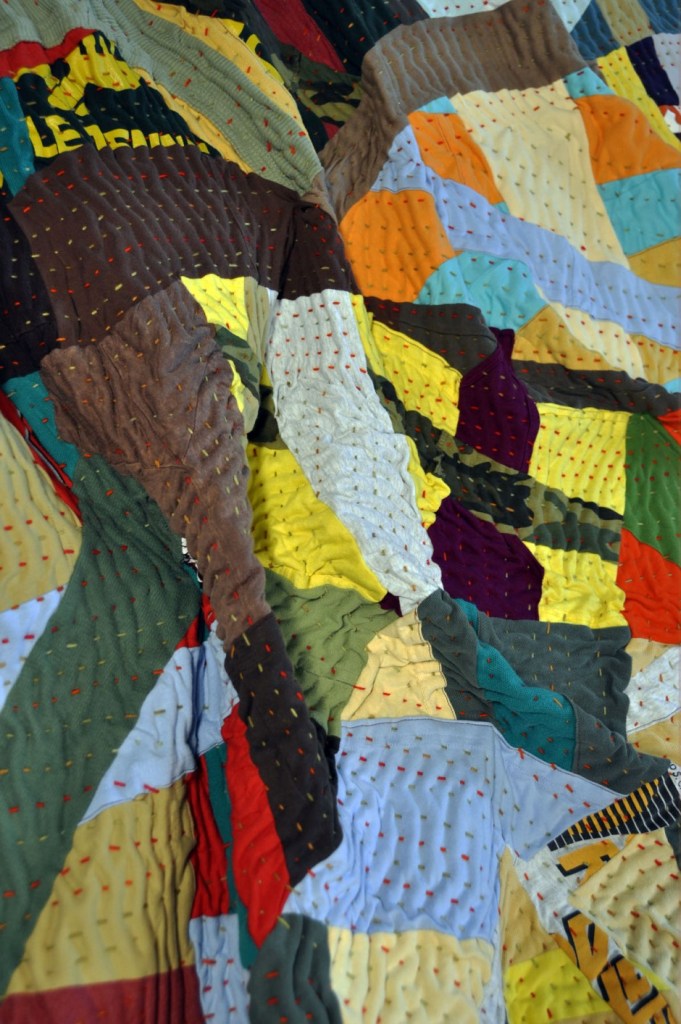
As I have reported many times before, I have lots and lots of t-shirt remnants and my daughter, Sarah and I are developing products to sell when she graduates from school this spring.

My latest idea is to sell large squares of knit fabric to replace tissue- kind of like a hankie but way more. I got the idea from taking care of my granddaughter Hailey. The last time I was with her, she had a runny nose. I decided to keep one of her little wash cloths in my pocket for her nose. It worked great- soft, reusable and durable.

This weekend, I made 100 of these for Sarah to sell. Here they are:

Cleaving

How does one access the Divinity within? The Hebrew word for glue is דבק dvk, the root for devekut, which in modern Hebrew is a synonym for dedication toward a particular goal.

The mystic meaning of devekut is cleaving or attaching oneself to The Holy One. It occurs frequently in Deuteronomy (4:4, 10:20, 11:22, 13:5, 30:20) in the context of cleaving, being near to or in communion with The Holy Spirit.

During prayer or meditation, devekut, cleaving, takes the practitioner up the spiritual ladder of the ten Sefirot, the divine aspects, to varied levels of mystical contemplation.

In 1994, I presented a Spiritual Tent for Women at the Pittsburgh Jewish Community Center to create an environment for devekut.

Nachmanides defined devekut as the state of mind in which one constantly remembers The Holy One’s Love.

Is there a practical way to become a master of intent, consistently focused on achieving this mystical cleaving?

It’s a work in progress.

A Spiritual Tent

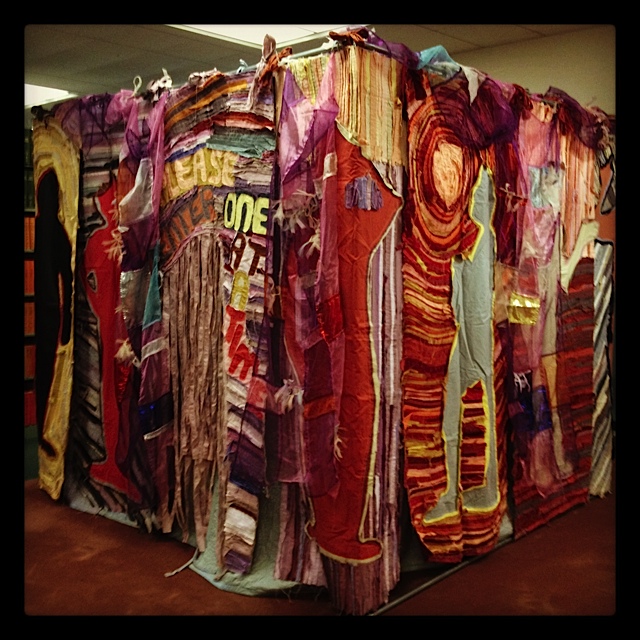
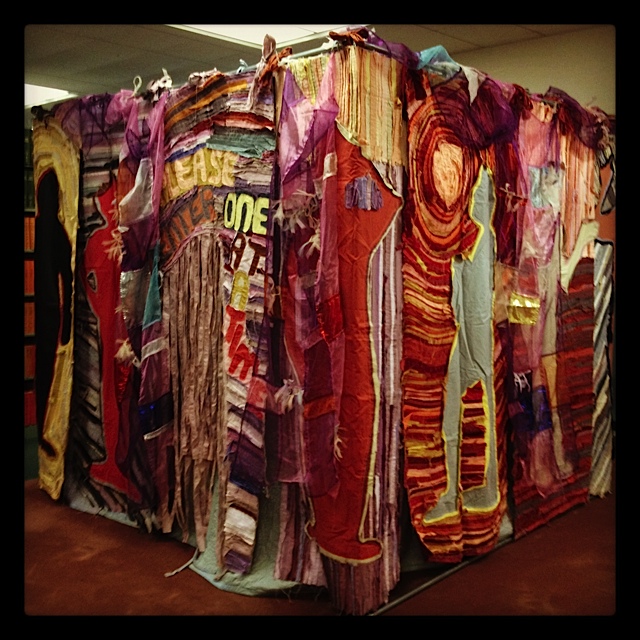
Currently installed in the Jaffe Book Art Collection at Florida Atlantic University is a spiritual tent I made over the summer of 1993.

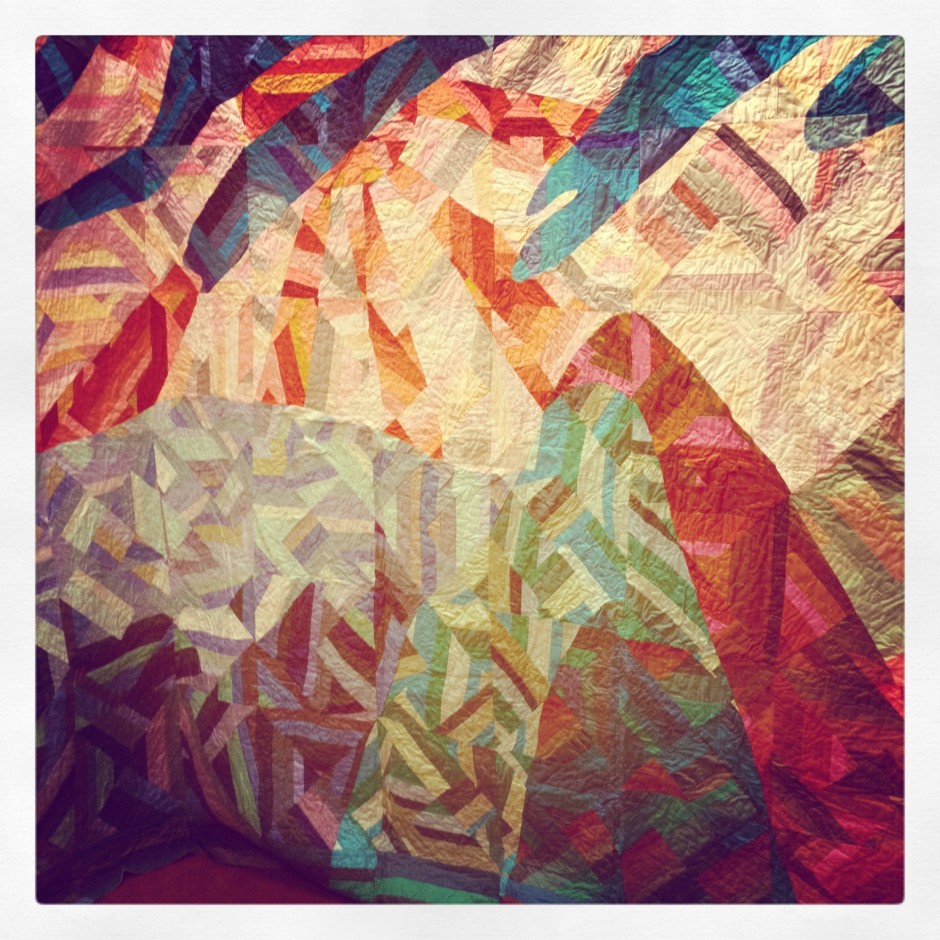
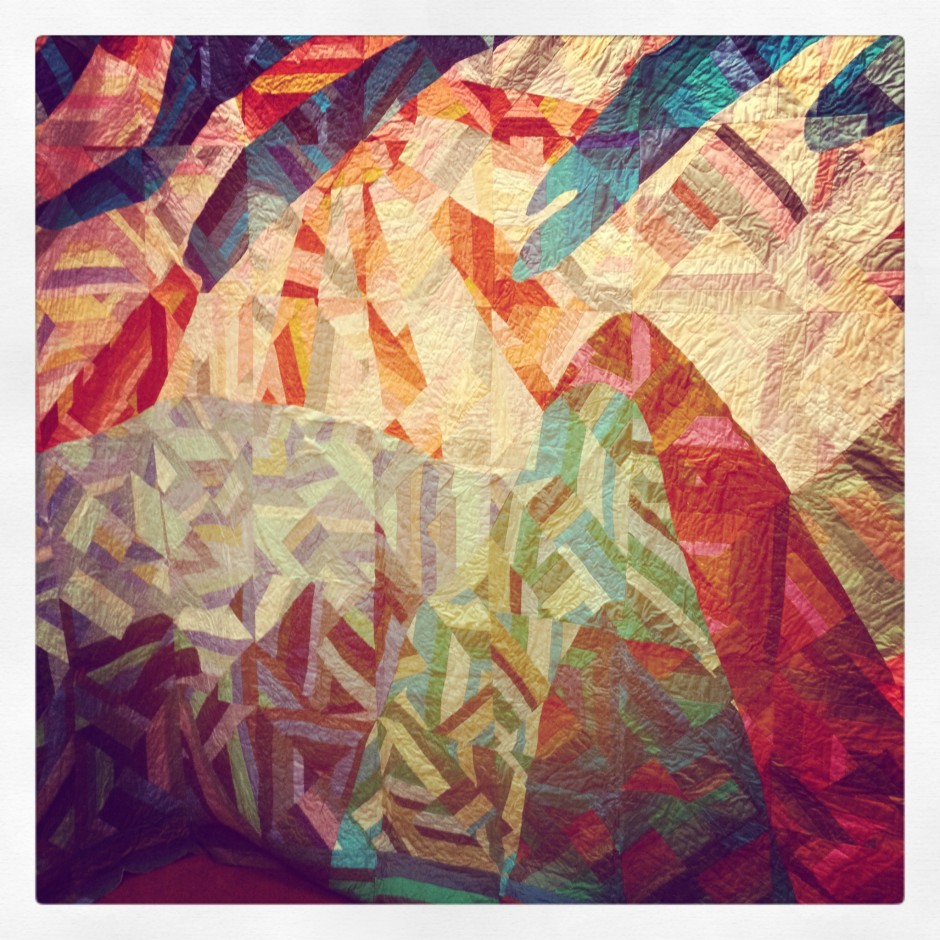
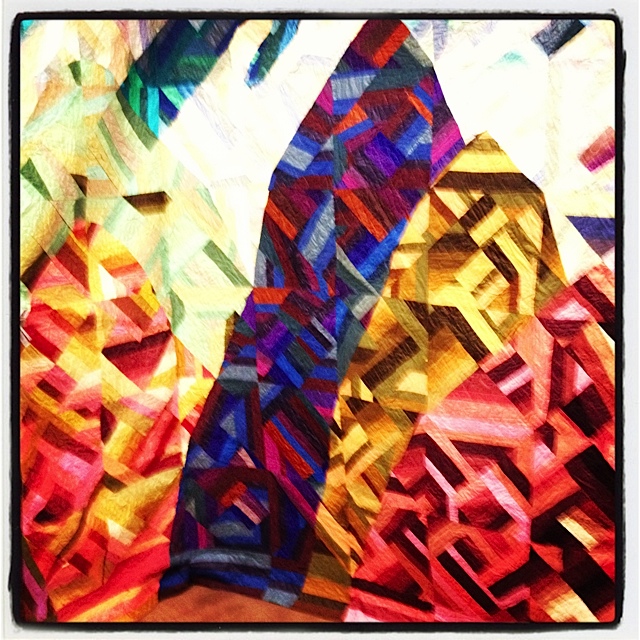
It is a two-sided tent 8ft X 8ft X 7ft high machine pieced and quilted out of 100% cotton purchased broadcloth. The outside is made of 12 soul panels created from applied strips of cotton. The inside is a patchwork scene of mountains, rivers, sky and clouds. The original sign on the door said, “Women, only, enter one by one.” Some ten years later, I altered the words to what is written now, “Please enter one by one”.

At the time I made it, I was trying to make a statement about the exclusion of women from the religious aspects of male dominated Jewish practice. In orthodox settings women are separated from men by a mechitza. In response, I made this tent for women that would exclude men.

Eighteen years later, standing in my creation, I was struck by the amount of time and effort I put into this project. I remember well the anger and exclusion I felt propelling me to make such a massive statement.

It’s a powerful piece and I’m proud to be the artist, but truth be told, if I were to create a new statement, I wouldn’t bother to go to such extreme lengths to exclude men. If they don’t see the value in including us- it’s their loss.

Community Quilting

The sisterhood of a local congregation, Tree of Life Or L’Simcha, enlisted my help to create a quilt for the entrance of their building.

We began with a first meeting where everyone brought meaningful pieces of cloth and I presented a PowerPoint talk giving an overview of quilts made with meaning and memory and a variety of the possible designs that would work with their materials.

A planning committee met with me to decide on the size and the pattern. We agreed on 25 diagonally set 14″blocks with 12 triangles and four corners to finish the edges making a finished quilt that is 80″ square.

This past Sunday, eight members of the sisterhood came to the studio and had a great time producing the blocks.

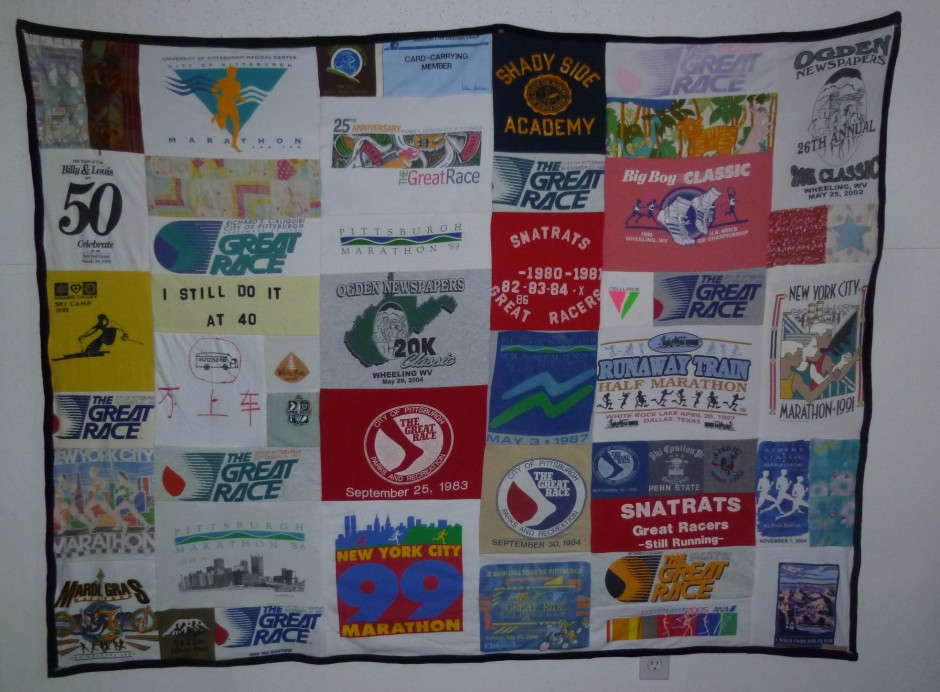
I put everything together and here is our finished quilt:

Every Day Zen

If someone asks me about Zen, I inevitably refer to the book, Everyday Zen by Charlotte Joko Beck.

The late Charlotte Joko Beck and her dharma heirs operate The Ordinary Mind School a non-hierarchical organization that uses an adapted Zen practice free from traditional patriarchal trappings with elements of vipassana meditation and the conscious engagement of emotions.

Everyday Zen is not achieving some blissful state or cultivating special powers or having happy feelings. It is about a simple meditation practice that removes external stimuli so that we are free to experience the most challenging part of reality: ourselves.

Life always gives us exactly the teacher we need at every moment. This includes every mosquito, every misfortune, every red light, every traffic jam, every obnoxious supervisor (or employee), every illness, every loss, every moment of joy or depression, every addiction, every piece of garbage, every breath. Every moment is the guru.

Zen practice isn’t about a special place or a special peace, or something other than being with our life just as it is. It’s one of the hardest things for people to get: that my very difficulties in this very moment are the perfection. When we are attached to the way we think we should be or the way we think anyone else should be, we can have very little appreciation of life as it is.

Enlightenment is not something you achieve. It is the absence of something. All your life you have been going forward after something, pursuing some goal. Enlightenment is dropping all that.

Wisdom is to see that there is nothing to search for. If you live with a difficult person, that’s nirvana. Perfect. If you’re miserable, that’s it. And I’m not saying to be passive, not to take action; then you would be trying to hold nirvana as a fixed state. It’s never fixed, but always changing. There is no implication of ‘doing nothing.’ But deeds done that are born of this understanding are free of anger and judgment. No expectation, just pure and compassionate action.

Practice can be stated very simply. It is moving from a life of hurting myself and others to a life of not hurting myself and others. That seems so simple — except when we substitute for real practice some idea that we should be different or better than we are, or that our lives should be different from the way they are.

We have to face the pain we have been running from. In fact, we need to learn to rest in it and let its searing power transform us.

But sitting is not something we do for a year or two with the idea of mastering it. Sitting is something we do for a lifetime. There is no end to the opening up that is possible for a human being. Eventually we see that we are the limitless, boundless ground of the universe. Our job for the rest of our life is to open up to that immensity and to express it. Having more and more contact with this reality always brings compassion for others and changes our daily life. We live differently, work differently, relate to people differently. Zen is a lifelong study.
A Quilt A Week

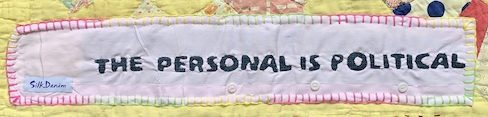
Speaking to a group last week, the question came up, “How long does it take you to make a quilt?”

To which I answered, “I make about a quilt a week.” This led to gasps in the audience, so I thought about it for a second or two and said, “Maybe that’s a bit of an exaggeration, but not much.”

Later on I figured out a quilt a week times forty years is only 2000 quilts. I’ve made at least that many probably more. There are factors that increase my output, like for the most part I send all hand quilting to the Amish or if I’m making pillows or bags, I make them in multiples.

I wonder how this week’s quilt, which is two sided, should count in the tally?

The French Knot

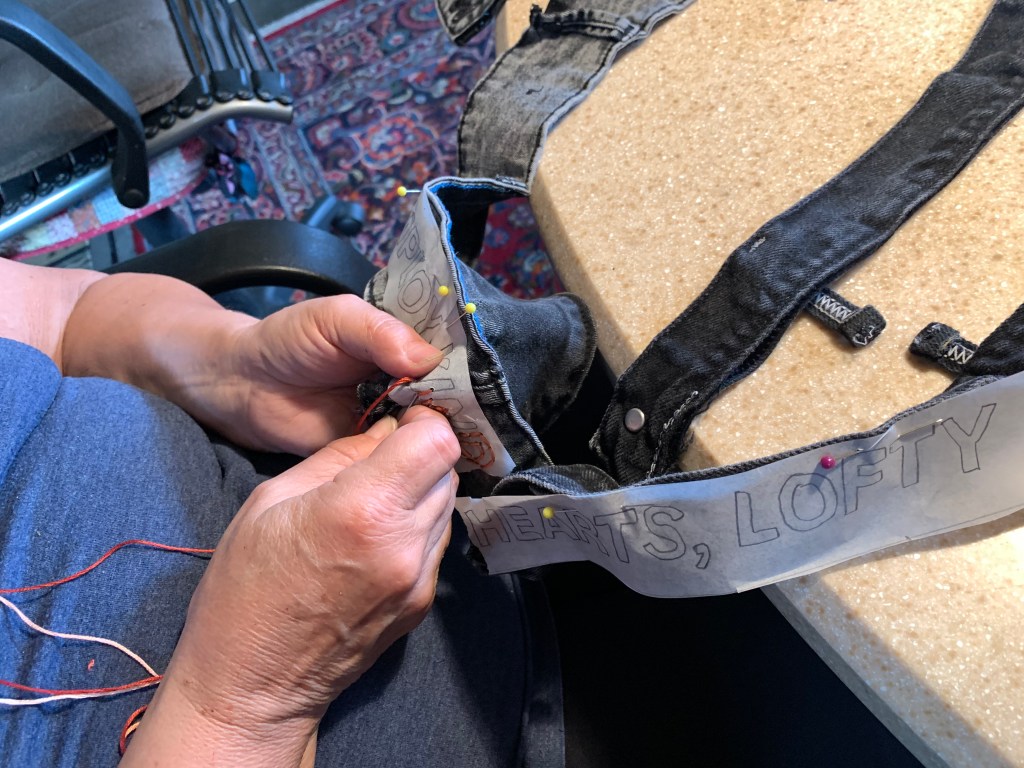
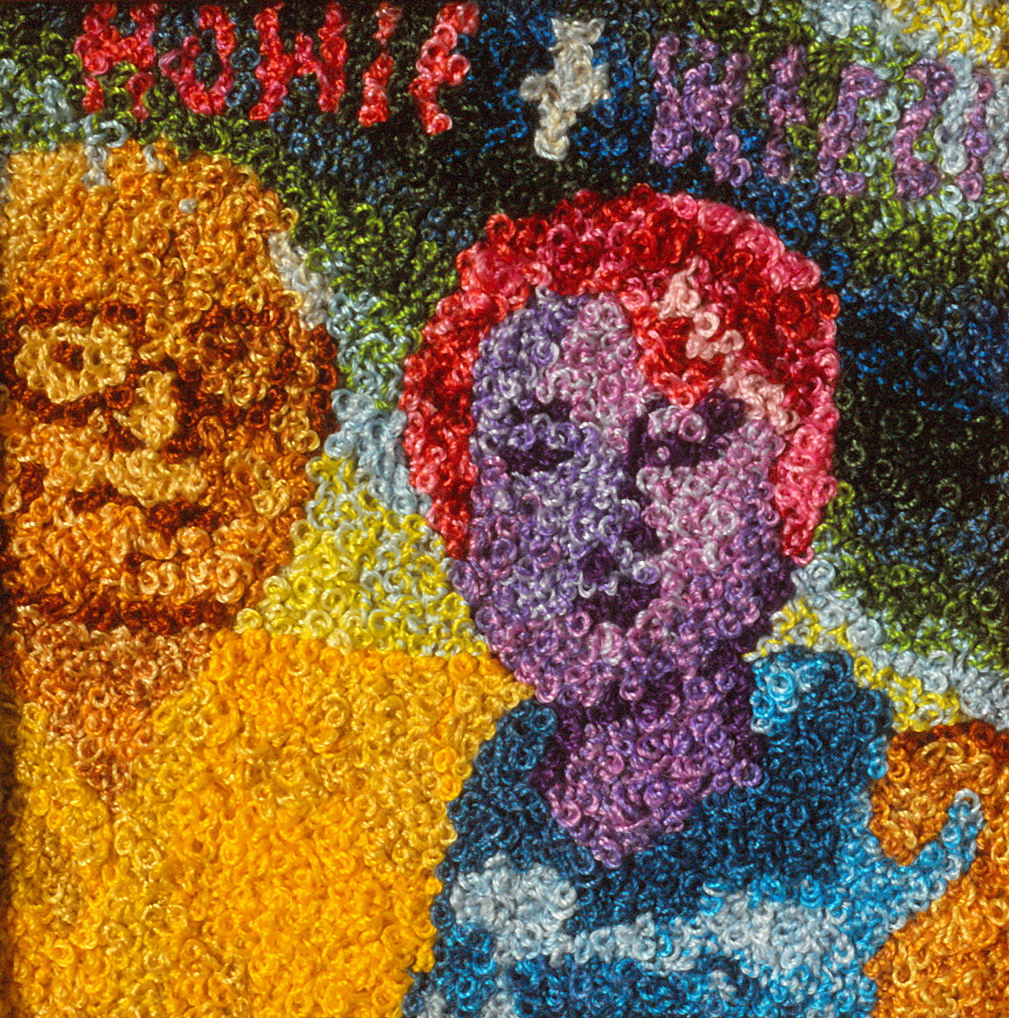
Embroidery always appealed to me and when I wanted to make this memory piece shown above of my Dad and me, I found the French Knot as my vehicle for interesting texture, scale and color variation.

The knots are formed with two different colors of regular sewing thread wrapped three times around a #8 embroidery needle. Regular sewing thread is great because it is available in hundreds of hues. I use a hue that has five levels of values and by putting two hues together, get great color depth.

I was so happy with the process of making the knots that I went on to do many portraits of my family and to create others by commission.

You can see a little bit more on the technical aspects of how I prepare a French Knot project by looking at Item No. 1 For My Container in this earlier blog.

Classic Quilting

Way back in the seventies when I started quilting, there were no special fabric manufacturers for quilt fabrics. Alexander Henry a cotton print textile design house saw a new market and began producing beautiful cutting-edge, original prints for quilters. One of their very best was this peacock feather print.

I used the fabric many times during my quilt shop days but mine and also my son’s favorite quilt used the feather fabric along with printed muslin fashioned after this antique diagonal alternate 9-patch:

Fast-forward to last year when I noticed my son was still clinging to this very worn-out and drab thirty-year old quilt. I longed for more of that magnificent fabric to make a replacement. It’s not being made any more but I was fortunate to locate three 4 yard pieces at Pink Chalk Fabrics and scarfed all of them up.

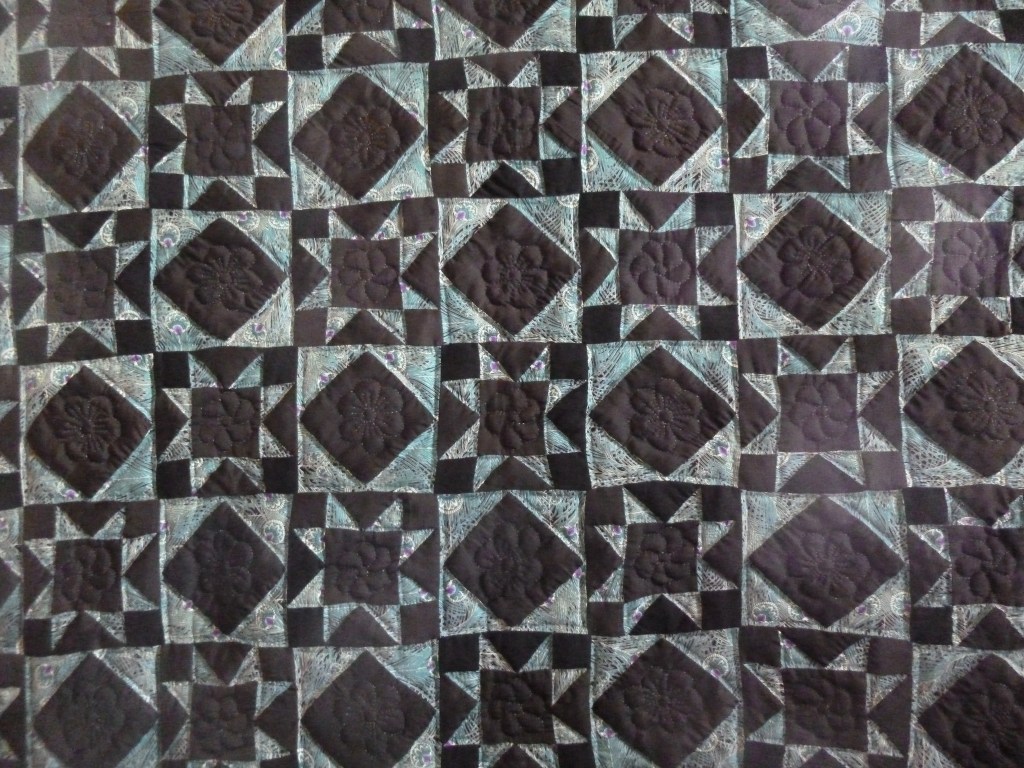
I made two of the pieces along with black raw silk into quilts for each of my granddaughters.

Seeing how great the new quilts turned out and remembering the fabric, my youngest daughter asked if I could make one more for her. I selected this pattern for hers:

While Steve was away for the weekend I pieced the Henry fabric with a beautiful black silk from a Japanese kimono. While the cat’s away, the mice will play! Now off to the Amish for quilting.