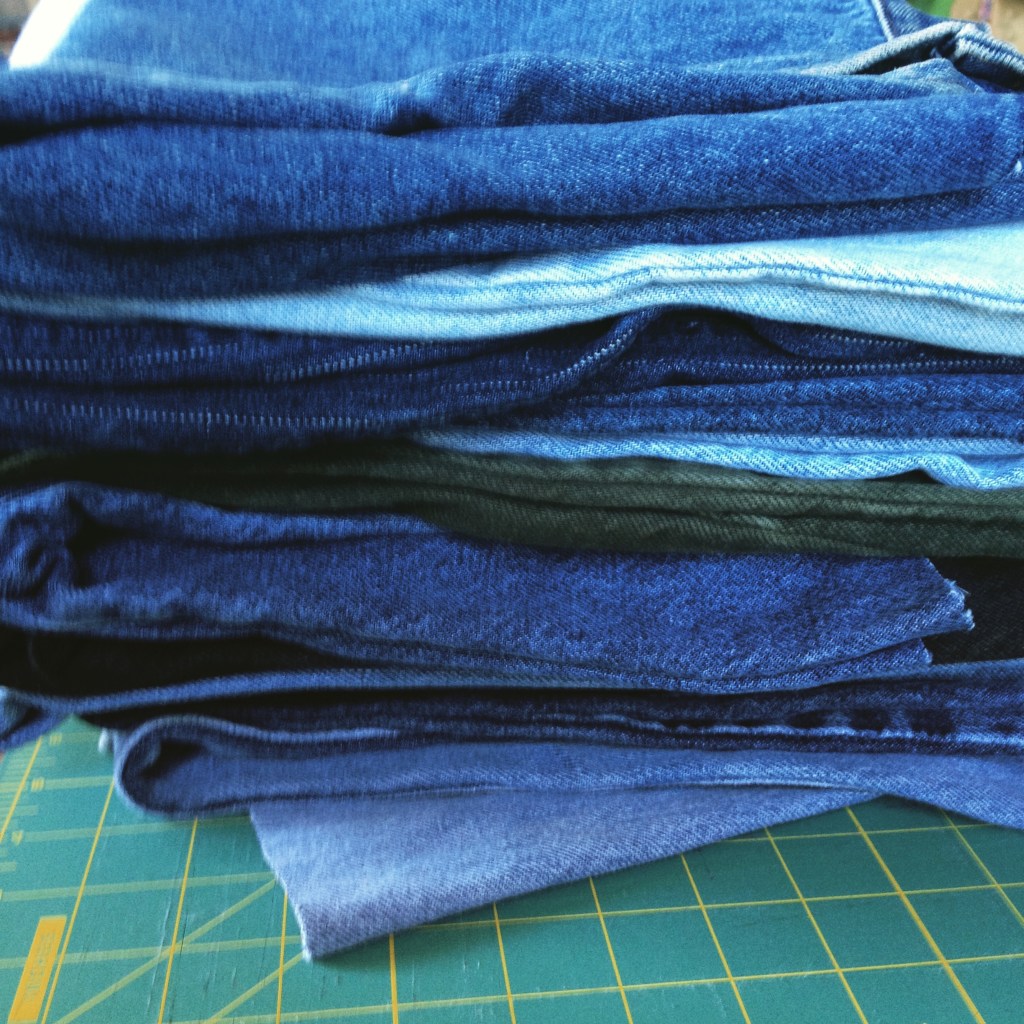
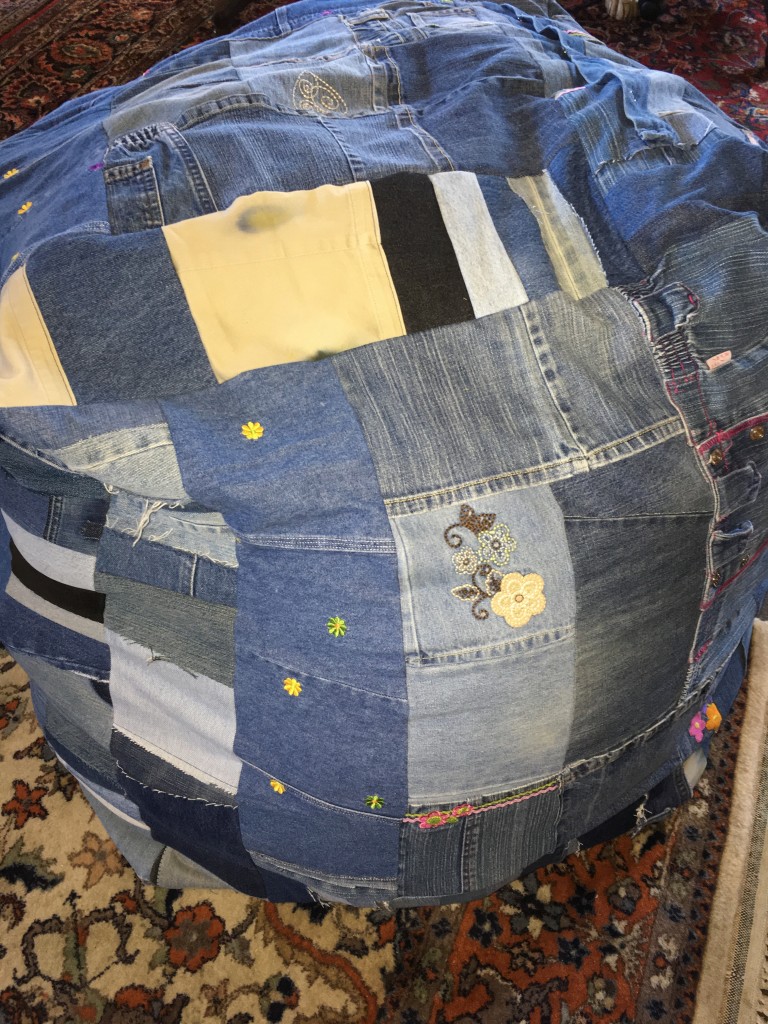
Whitewashed figures daven deep Considering the weight of time Crushed and torn and cast away A vintage shore their sanctum. She harvests them, denim by the pound.
Her basket brims with archetypes The demons and the gods alike Dance sacred weft and warp Weavers of the infinite loom. She blesses them, denim by the pound.
A Zipper maps the spiritual path A button unlocks truths A snap reveals the song of night Out of nothingness comes the root. She transforms them, denim by the pound.
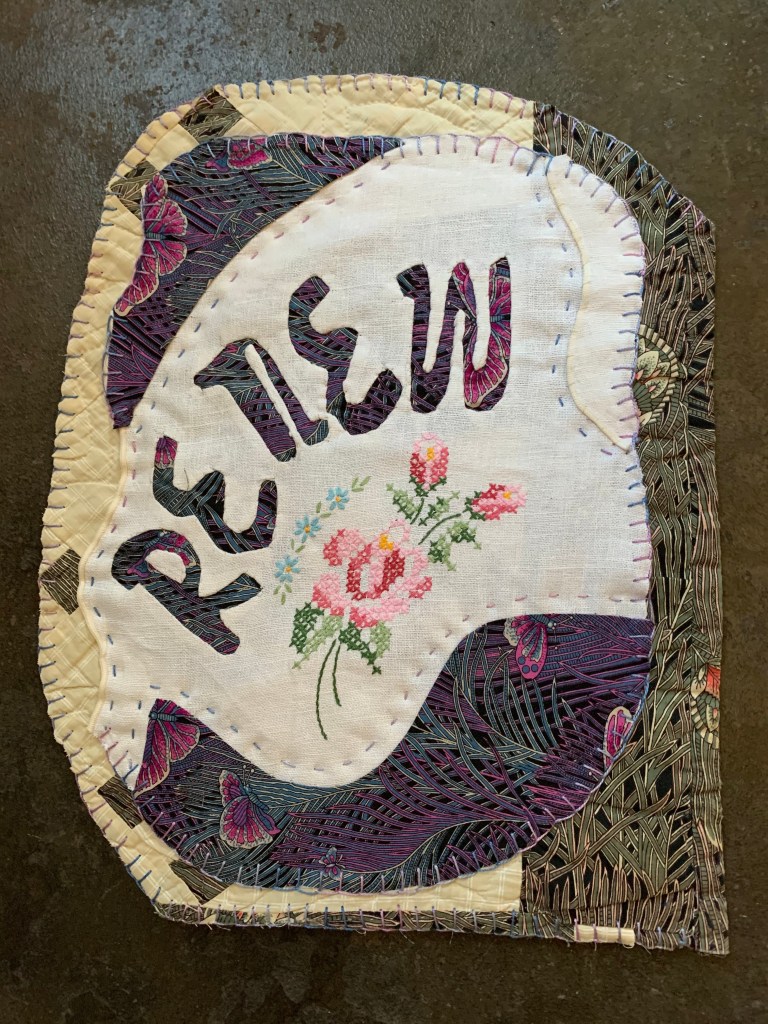
These weathered refugees bow down And welcome the unraveling Ren garments joined in silent prayer Shape-shift through time and space. She resurrects them, denim by the pound.
Karen Bryant Inspired by the work and writing of Louise Silk October 14, 2018
Preformed at A Gathering of Jewish Learners: 1996 Summer CAJE Conference
The performance space is arranged with chairs forming two large concentric circles. The inner circle is made of 26 individually separated chairs. The outer circle has two or three chairs placed side by side behind each of the inner 26 chairs. On the outer circle chairs are 26 individual pieces of “pellon” and assorted colored markers. Each fabric piece has a line from the prayer drawn on it in pencil. The prayer lines are arranged in order going left around the circle. Participants are greeted by the artist as they enter the area. Each person is handed one statement from below, a program, and a copy of the prayer. They are instructed to sit anywhere in the inner circle. The performance begins with an explanation of the task of the group which is to perform the Kaddish Prayer after they have learned about Performance Art, Quiltmaking, and the Kaddish Prayer. The microphone is passed so that each person reads a relevant statement, first about Performance Art, then Quiltmaking, and finally about the Prayer. Next each participant connects with an individual portion of the prayer, by decorating one of the pellon fabric pieces. As they are working, the artist leads a discussion helping the group agree on how to perform the prayer. The performance ends with the actual recitation of the prayer. If time allows, there is a “dress rehearsal” with evaluation and modification, and a discussion of how and why the participants decorated their quilt pieces. Participants keep their part of the Prayer Quilt.
THE ART OF PERFORMANCE ART (Printed on blue paper)
The “observer” is a notion that belonged to the classical way of looking at the world. The observer approaches the world without taking part. But our social reality is not to just observe. Our vision is constructed from the way our private beliefs and intentions actively interact and merge.
We live in a toxic culture. If one’s work is to succeed as part of a necessary healing process, there must be a willingness to abandon old programming. The person who is in touch with the future is the creative personality who is in touch with the necessary psychological tasks that prepare for conflict solutions to emerge, and for the healing of the toxic defects.
Increasingly, as artists begin to question their responsibility and perceive that “success” in capitalist, patriarchal terms may not be the enlightened path to the future, they will change from demystifier to cultural healer. Healing is the most powerful aspect of reconstructive postmodernism art movement.
As participating co-creators, we become ourselves the shapers of new frameworks, the orchestrators of culture and consciousness.
In our present situation, the effectiveness of art needs to be judged by how well it overturns the perception of the world we have accepted.
It is not enough for artists to create or express an idea; they must also awaken the experiences that will make their ideas take root in the consciousness of others. To do this the artist must empower the participants and raise their consciousness as to their shared conditions.
Most of us see art as a tradition in which individuals and individual art work are the basic elements. We do not recognize that it contains the standard capitalistic values of pursuit of power, production, prestige and accomplishment. In this mind set, it is hard to see art as interactive, inclusive of ritual process, as a possible act of healing, and as an awareness of living in the world soul.
Interaction is the key that moves art beyond the aesthetic mode: letting the audience intersect with, and even form a part of, the process, recognizing that when observer and observed merge, the vision of static autonomy is undermined.
A great deal of modern art was intended to be against the audience. But there is another possibility. Art that collaborates consciously with the audience and is concerned with how that audience connects, can actually create a sense of community.
Performance art is a prototype that embodies the next historical and evolutionary stage of consciousness, in which the capacity to be compassionate will be central not only to the ideas of success, but also to the recovery of both a meaningful society and meaningful art.
THE ART OF QUILTING (Printed on pink paper.)
Quiltmaking is a unique and powerful medium of expression signifying shelter and tranquillity. Particularly with our high-tech age, the quilt and the quilting process remain powerful metaphors for sharing and connecting with the human community.
Quilts have always been made to acknowledge and honor such life events as birth, friendship, marriage and death.
The quilt satisfies the public’s craving for both the old and the new, familiar and modern. It can be composed of ordered soothing geometric tactile materials in familiar techniques yet it’s bold graphic design bear a striking resemblance to modern art.
In this country during the 18th and 19th centuries, many women stitched their thoughts, hopes and fears into their needlework. In this century, the idea of using quilting to express a social or political message has evolved into a global activity in which men, women, and children participate.
The names of individual traditional quilts from the last two centuries tell stories of the times in which they were designed. Today, it’s not so much the individual quilt design but the communal process of creating and displaying quilts that is important.
Oliver Wendell Holmes advised, ”Take your needle, my child, and work at your pattern; it will come out a rose by and by. Life is like that… take one stitch at a time. Taken patiently… the pattern will come to right.”
Pete Seeger said. ”We’ll stitch this world together yet. Don’t give up.”
Although quilt designs are named, each design is rarely the same twice. The variations in borders, color, fabric, thread, and quilting stitches make it impossible for two quilts to be identical.
Because they were not considered artists, quiltmakers were free from the stereotypes of what women’s art should be. They were outside the repression of the “high” art tradition. They succeeded in building an art form so strong that its influence has extended over 400 years.
In the past decade a quilt revolution has been taking place. It has pulled the covers off the bed and nailed them to the wall. No longer are quilts patched from treasured hand-me downs: Grandmother’s calico curtains, Mother’s wedding gown, or Aunt Ida’s petticoat. Now new fabrics are carefully selected, custom dyed and painted like canvas. Hand and machine work may co-exist on a single quilt. New techniques in quiltmaking include air brushing, photography, silkscreening, batiking, pleating, and computer generated designs.
THE ART OF KADDISH (Printed on green paper.)
Originally, the Kaddish was a hymn to the greatness and holiness of God’s name, recited after a lesson devoted to the study of Torah or at the close of a service of worship. It most probably originated in the talmudic period because it is written in Aramaic, the language spoken by the Jews of Babylon.
Two important ideas are involved in the recital of the Kaddish: the mighty role of Torah in Jewish spiritual life and the great merit attached to the recital of formula that constituted Kaddush Hashem, Sanctification of God’s name.
Kaddish became associated with paying respect to the memory of the dead because at one time lectures on Torah were given in the house of mourning the week after the death of a learned man as a means of honoring his memory. Later, this period was prolonged and lectures were continued for a whole year.
Traditionally, The Kaddish is an Aramaic prayer said 7 times a day in the prayer service. This is based on the verse “Seven times a day I praise Thee” from Psalm 119:164.
The Kaddish yatom- Orphan’s Kaddish- is said at the services by a mourner for the first eleven months of the year and at each recurring Yahrtzeit.
Kaddish means sanctification.
Rabbi Akiba is said to have taught an orphan to recite “May His great Name be blessed” in order to rescue his father from Gehinnom (punishment in hell).
The nucleus of Kaddish is the congregation response,” May His great Name be blessed.” It is around this response, rooted in Daniel 2:20, that the entire Kaddish evolved. The sages said,” He who responds ‘Amen. May His great Name be blessed’ with all his might, his decreed sentence is torn up” (if Heaven has decreed evil for him). By this is meant that one should say it with his heart and soul and should not merely pronounce it with his lips without having in mind what he is saying. A slight pause should be made between Amen and “May His great Name” because the word Amen serves as a response to what the community prayer has said and what follows is an independent statement.
Kaddish contains ten expressions of praise: exalted, sanctified (the first two words Yitgadal veyetkadosh), and the eight words: blessed, praised, glorified, extolled. exalted, honored, elevated, and lauded. The ten expressions correspond to the ten utterances and Ten Emanations by which God created the world, the ten expressions of praise King David uttered in the Book of Psalms, and the Ten Commandments. The reason the first two praises are separated from the other eight is because the first two commandments were given directly by God to the Israelites whereas the last eight were transmitted to the people by Moses.
A simple practical idea from the art of tea or Sadou, the way of tea.Ichi-go ichi-e (一期一会) is a concept expressing the ideal roughly translated that means one time, one meeting or one encounter; one opportunity. In the way of tea we respect and honor the moment as a once-in-a-lifetime gathering, a simple encounter that will never happen again. Ichi-go ichi-e reminds us that each tea ceremony (and each moment) is unique unto itself. Even though the elements may seem familiar, remember, they are not.
One Time; One Meeting; One Moment; Never Repeated; Totally Unique and Original.
…The story of human progress is truly heroic. It is glorious. It is uplifting. It is even, I daresay spiritual….
…We are born into a pitiless universe, facing steep odds against life-enabling order…We are made from crooked timber, vulnerable to illusions, self-centeredness, and at time astounding stupidity.
Yet human nature has also been blessed with resources that open a space for a kind of reception. We are endowed with the power to combine ideas recursively, to have thought about our thoughts…We are deepened with the capacity for sympathy-for pity, imagination, compassion, commiseration….
…We live longer, suffer less, learn more, get smarter, and enjoy more small pleasures and rich experiences….We will never have a perfect world…but there is no limit to the betterments we can attain…
And the story belongs not to any tribe but to all of humanity-to any sentient creature with the power to reason and the urge to persist in its being. For it requires only the convictions that life is better than death, health is better than sickness, abundance is better than want, freedom is better than coercion, happiness is better than suffering, and knowledge is better than superstition and ignorance.
In this very moment lies an invitation to the Silence that reveals itself when you simply stop. Perhaps your mind is asking, “Stop what?” Just stop. Stop asking. Stop trying. Stop pretending. Stop believing your stories of whom you are or where you have to go. Stop thinking you know something don’t know something. How? There is no “how”; “how” is more mind activity. Silence needs no “how.” It simply IS. You simply ARE. If you want to discover what you truly are, just stop-even an instant long enough. What is here when you simply stop?
Do not be too hard on yourself. All of your attempts to shame, degrade, renounce, reject, or beat upper ego into submission only serve to strengthen your belief in its separate existence, which is actually an illusion. You might as well allow yourself into your heart. Love is the greater dissolver of separation. Yet from the Heart that accepts all and sees with both clarity and love, you are invited to question the questioner; double the doubter; look for the seer.
Come into the sense of Now, quietly present to your innermost Self. Invite your attention deep inside, beyond the concepts covering your naked, open awareness. Bypass all remembered definitions of your self, even for a moment, and come inside your Heart…. Turn your attention toward your innermost silent Source; feel its Presence. Let yourself return again and again to this felt sense.
Until we have fully embraced our humanity with out relinquishing our divinity, we have not yet come Home. Love is the invitation beyond separation.
While you sense the extraordinary in each moment and each form as it is, including your own, there is no need to be seen to be extraordinary. Dwelling in the ordinary, you can appreciate the natural unfolding of life, moments, thoughts, feelings, body sensations, spontaneous actions, whatever appears and disappears….Dwelling in the ordinary means laughing when something is funny, crying when something is sad, enjoying the taste of food when you eat, feeling compassion in the face of pain or suffering, accepting what comes and accepting what goes, with love infusing it all.
There is something larger than self, that we either mangle or make significant. Dante
According to James Hollis these are the stages of our common developmental journey:
1. One is called to the next stage, to a task. 2. The task that each of us is to address is different, the summons to individual personhood. 3. Such tasks pull us out of our comfort zones. 4. In these moments, we risk inflation, as much as intimidation. 5. We are summoned forth redeeming values that has been lost or repudiated through the adaptations of the society. These must be revisited, integrated, lived, in order to bring healing to the earth or trigger the next stage in our personal development toward wholeness. 6. Flight from this restorative task, as well as the honest experience of exile, will bring retribution, neurosis, repressed power and energy. 7. The pathology that arises from any flight from the task is necessary to get out attention. 8. Suffering is the requisite for consciousness and recovery. 9. Homecoming is the goal, but not a geographic home out there or a comforting theology or psychology but a healed relationship with self integrating all parts of the soul and its journey to allow spontaneous generosity in every circumstance.
Failure to incorporate these challenges, tasks, losses into our lives means we have not yet accepted the full package life brings to us. Everything given to us is lost and redeemed by us through more conscious affirmations and actions of values that we continually uphold and serve.
Hi Louise, The tallit just came. Oh my goodness! It is so beautiful and so Jonah! Rick and I are thrilled. Actually, we are more than thrilled—we are so moved by your work. Thank you so much. The denim tote is adorable. Thanks, Bobbi
Dear Louise, I received my original SilkDenim Bag on Friday and I have already used it twice. I love the bag and the creativity that went into its formation. Thank you so much.! And please know I will think of you every time I use my tote. Martha
These potholders awesome! Wonderful craftsmanship and they are great to use. Amazing design to slide your hand in the pocket. A funky way to stylishly recycle. Even my husband liked them! Can’t wait to purchase more. They would make great gifts! Kisber
This quilt is one of the best purchases I’ve ever made! I enjoy reading under it, watching TV under it and sleeping under it. It’s visually interesting and has garnered many positive comments from family and friends. The quality is great and the comfort it offers is incomparable. I want another one! James
Thank you! We received your quilt and table runner today. Both are beautiful! The colors are a surprise, since each is different from the sample shown on Etsy. We love the way they turned out! They match our dining room and bedroom even better than we hoped. March
One of the biggest problems when deconstructing jeans for SilkDenim projects is what to do with all of the unused zippers? It would be a crime to throw them into the land fill but often it requires more time and energy that it’s worth to make something reusable from them.
Thus the assignment was to combine multiple zippers with left over denim and tee-shirt remnants into an attractive, useful, and innovative bag.
This turned into a very technically sophisticated construction. Each zipper is a closed compartment, one building on the next from the bottom up. Next an interesting raw edge on a back piece of denim that gets a pocket and a waist button and finally a cotton tee-lining. The strap is deconstructed and reconstructed waistbands and then the whole piece challenges the machine (and its operator) with it’s many layers until with great organization, patience and resolve, everything comes into one amazingly brilliant SilkDenim iPad-Plus Carrying Bag.











 BubbeWisdom